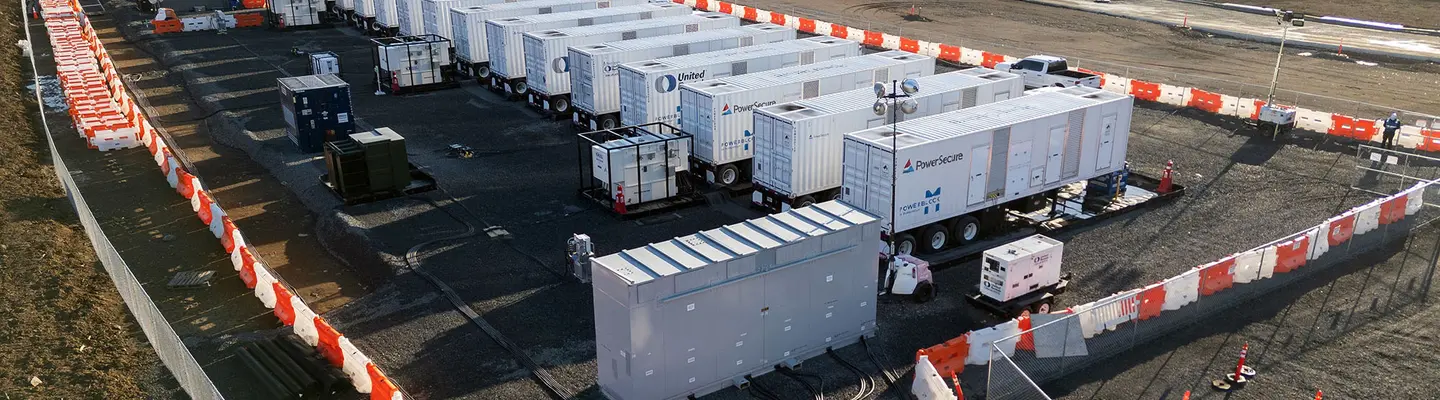
Battery energy storage systems (BESS) are transforming how construction contractors, facility managers and utilities generate and use power. They can reduce fuel and electricity consumption, driving cost savings while minimizing greenhouse gas emissions. They also help provide critical backup power and increase the reliability of the energy grid. But exactly what is a BESS, and what are the benefits of battery energy storage systems?
United Rentals, which is helping customers of all sizes pioneer the use of these systems, has the answers.
What is a BESS?
A BESS stores extra energy from an energy source, such as the power grid, a solar array, a wind turbine or a generator, and supplies it later when energy is needed. It contains:
- High energy-density batteries
- Inverters that convert incoming AC power to DC power and back
- A control center that monitors the load and controls when the batteries charge and when they supply electricity.
Most BESS today contain lithium-ion batteries, but other battery technologies are available, and more are emerging.
For portable power needs, BESS are available in skid-mounted units and trailer-mounted units that can be linked together for more power. Massive custom-designed BESS installations for industrial and utility use are housed in storage containers or other enclosures.
How does a battery energy storage system work?
When a BESS is connected to a power source, that power source charges the batteries. For example, when a BESS is paired with a generator, the generator charges the batteries while it runs. When the energy demand is low, such as at night, the BESS control center shuts off the generator and the batteries take over the load. When the batteries near depletion or more power is needed, the control center turns the generator back on.
A utility-scale BESS uses algorithms to determine when energy generated by renewable sources such as wind and solar farms should be stored and when it should be moved to the power grid.
Types of portable and mobile BESS
Portable battery energy storage solutions such as the POWRBANK can be connected to a generator or used on their own in standalone mode. When a BESS is connected to a generator, it can often act as the primary source of power, with the generator running only long enough to charge the battery.
One of the largest batteries in the rental market, the Termaco TREE 500kW, can be paired with a generator for energy-intensive jobs. On one jobsite, the TREE was connected to a 100kW generator and used to power an 8-ton tower crane. It slashed generator run time from 24 hours per day to just 2.5 hours per day.
For convenient continuous power, hybrid power systems such as the towable ANA Energy Boss include the BESS and a generator in the same container. The Hipower EHR Solar Battery Generator, developed in conjunction with United Rentals, takes hybrid power systems, and sustainable power, to the next level. It has a 10kW solar array that sits on top of a unit that houses batteries and a 50kVA propane generator.
Common BESS applications
Battery energy storage systems are increasingly popular now that battery prices have dropped. Below are some of the most common applications.
Off-grid applications
- Optimizing generator use on construction sites
- Powering large, outdoor events such a sports tournaments and music festivals
- Powering film sets and location shoots
Commercial and industrial facility applications
- Providing immediate-start backup power during grid power outages, especially for data centers, hospitals, treatment plants and other mission-critical facilities
- Enabling peak shaving and load leveling for grid-connected facilities
- Supporting microgrids used by commercial and industrial markets
- Providing cost-effective temporary power during refinery turnarounds
Utility-scale applications
- Increasing the reliability and efficiency of the power grid by providing backup power and boosting capacity
- Supporting the integration of renewable energy sources by storing excess power from wind and solar farms for later use
- Enabling peak shaving and load shifting, which reduce costs for energy customers
Benefits of a battery energy storage system
The benefits of battery energy storage systems are many and range from energy cost savings to increased sustainability.
Energy cost savings
On off-grid sites, pairing a generator with a BESS produces significant cost savings. By slashing generator run time, it can cut fuel costs by as much as 80%, and even more when loads are highly variable. A BESS also allows contractors to downsize their generators, which drives further cost savings.
“At United Rentals, we find that contractors typically oversize their generators by as much as 50% to 75%, which drives up fuel costs,” said Dan Gribbell, sales and marketing director, Power/HVAC at United Rentals. “They also tend to run generators 24/7 when they don’t need to. A BESS can solve both issues.”
For grid-connected facilities and utility companies, a BESS can supply stored energy during demand surges, when the cost of electricity is highest. This allows companies to buy grid energy during off-peak hours, when prices are lower.
Reduced carbon emissions
By minimizing generator run time, a portable BESS can shrink the carbon emissions produced by generators by as much as 80%, helping companies meet sustainability targets. Pairing a BESS with an alternatively powered generator such as a propane generator results in even lower emissions.
Generating power with a solar array or hydrogen generator and storing it in a BESS delivers a zero-emission power solution.
Noise reduction
Unlike a diesel generator, a BESS operates nearly silently. That's a benefit on construction sites with noise restrictions, at music events and on film sets.
Backup/emergency power
A BESS can power the load if the primary or backup power source fails. Batteries supply power even faster than a backup generator can kick in, ensuring that critical systems remain online.
When the local power grid fails due to heat waves or storms, a utility-scale BESS can allow energy customers to keep using air conditioners, heaters and refrigerators.
A greener utility grid
A utility-scale BESS makes energy from renewable sources such as wind and solar more reliable. When the sun isn’t shining or the wind isn’t blowing, stored energy keeps a predictable amount of energy flowing.
Matching the BESS to the application
Battery energy storage systems are rapidly gaining popularity as reliable, cost-effective, environmentally friendly solutions for a variety of power needs.
United Rentals can teach customers how to size a battery energy storage system and guide them to the best portable BESS for their worksite, project or event. The Power & HVAC team can also configure plug-and-play hybrid power solutions. For large-scale applications, United Rentals can build and deploy systems ranging from 50MW to over 1GW.
 Facebook
 X
 Linkedin
 Email
 Print
 Copy Link
 RSS Feed
